Bioplastic Made by Microorganisms
Polyhydroxyalkanoates, or PHAs, are a family of naturally occurring biopolymers produced by microorganisms. Under the right conditions, these microorganisms convert carbon-rich feedstocks into PHA, which is stored inside their cells as an energy source.
Once recovered and purified, PHA can be processed into resins suitable for manufacturing products such as bottles, containers, films, and other plastic applications.
Unlike conventional plastics made from petroleum, PHA can be produced from renewable and waste-derived feedstocks and is designed to biodegrade under appropriate environmental conditions.

Key Properties
PHA materials can be engineered for a wide range of applications. Depending on their composition and formulation, they can offer:
-
Rigidity or flexibility
-
Good barrier performance
-
Compatibility with conventional plastics-processing equipment
-
Resistance to moisture and oils
-
Biocompatibility
-
Biodegradability in a range of natural environments
PHA properties can also be adjusted through fermentation, polymer composition, and material formulation, allowing the material to be tailored for specific product requirements.
Why PHA?
PHA offers a different approach to sustainable materials because it addresses both the beginning and the end of the plastics lifecycle.
At the beginning of life, PHA can be produced using renewable resources or organic waste rather than fossil fuels. At the end of life, it can biodegrade under suitable conditions without leaving persistent microplastics behind.
This makes PHA particularly valuable for products where recycling is difficult, contamination is common, or plastic is likely to escape into the environment.

PHA vs. Fossil-Based Plastics
Conventional plastics such as polypropylene, polyethylene, and polystyrene are inexpensive, durable, and widely used, but are made primarily from fossil resources and can persist in the environment for decades or longer.
PHA can provide similar functionality and durability to fossil-based plastics across many applications, performing throughout the product’s intended lifetime.

What Happens at the End of Its Life?
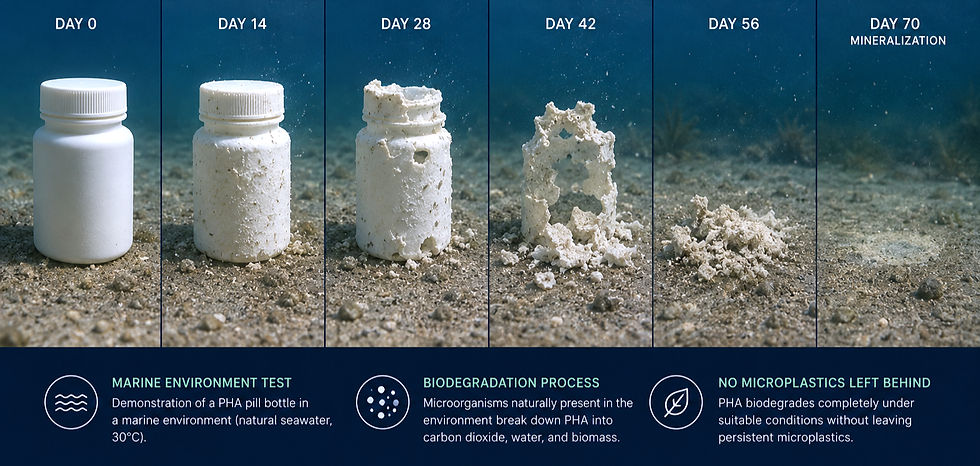
PHA is biodegradable because naturally occurring microorganisms can recognize and break down the polymer. Under suitable conditions, they convert it into natural end products such as water, carbon dioxide, and biomass.
The rate of biodegradation depends on several factors, including the PHA formulation, product thickness, temperature, moisture, microbial activity, and the surrounding environment.
PHA can biodegrade in environments such as:
-
Industrial composting
-
Home composting
-
Soil
-
Freshwater
-
Marine environments
Launch PHA
Launch produces PHA using industrial organic waste as a feedstock.
Our approach combines waste valorization, advanced fermentation, and application-focused product development to create high-performance materials with a more circular lifecycle. By turning waste into new bioplastic products, Launch reduces dependence on fossil resources while helping companies integrate more sustainable materials into existing value chains.
Ready to LAUNCH something better?
